Has anyone seen a tool that can design custom RC airplanes from requirements?

Realmdyz

New member
It will definitely get to the point of being able to do good engineering eventually - just likely a few years out. Probably will be a bit out of the price range of your average RC hobbyist with the compute power required for another few years after that. Part of the challenge is that designing an RC plane requires doing just the right amount of bad engineering to get it to work and involves a lot of intuition and hands-on know-how. I probably take one of the more rigorous engineering approaches to designing planes on this forum and if I took my design process into an actual engineering environment I would be

  1. Told to seek help because doing CFD without getting paid for it is not normal
  2. Laughed out of the room if I tried to present most of my process as good engineering - real engineering is exceptionally rigorous because it needs to be to keep people safe but that also makes it very time-intensive and expensive and that is likely the market that AI companies will initially target
That's a really interesting way of putting it—"just the right amount of bad engineering." I think I know what you mean.

It sounds like a lot of successful RC design comes from experience, intuition, and rules of thumb rather than trying to optimize everything mathematically??
 

Gadeirus

Active member
It sounds like a lot of successful RC design comes from experience, intuition, and rules of thumb rather than trying to optimize everything mathematically??

Personally I would likely agree with that. I think the only realm of RC aircraft where proper optimization really occurs is high-end sailplanes.

For everything else, it really doesn't matter all that much. With RC airplanes, it is so incredibly easy to make something really strong and with stupendous power-to-weight ratios that all other considerations that you would take in a full-scale airplane design really just get pushed aside. For instance that's why so many model airplanes use what are, honestly, not particularly great airfoils. It just doesn't matter.
 

telnar1236

Master member
That's a really interesting way of putting it—"just the right amount of bad engineering." I think I know what you mean.

It sounds like a lot of successful RC design comes from experience, intuition, and rules of thumb rather than trying to optimize everything mathematically??
Pretty much, you can use engineering to optimize anything, but the majority of RC designers don't want to. Like Gadeirus said, you see it some in gliders, and I'd also add higher end pylon racers to that list - those got really competitive for a while and you got things like the MH laminar flow airfoils out of that - but in general there's no need - chuck a Clark Y airfoil on it, put the CG at 20% MAC, and go have fun.
 
Last edited:

L Edge

Legendary member
Another way to look at designing these days is that prop planes and foam, you just slap your wings on your fuse, add some tail feathers, slap some motor's/prop's anywhere on it and it flies. Agree like others.

Now add 3D printing and combo's of foam planes can go faster and "mucho" scaling is done easily. Basically the same planes and a few new ones. So the tool for design is not really needed.

Now enter EDF's which in actuality, changes the picture. This is the problem child of the RC family. They are under powered and will need to follow rules and regimentation. Some success and rules have been established for dealing with 1 EDF in some aircraft, even there, some fail to fly in the total flight environment. (Example, F-22 with stealth design added at EDF exhaust, will produce pitch up condition and in tight turn will spiral down and out of control lacking rudder).
How many 2 EDF's planes fly, the list is very few? Problems galore for the NYGAD F-47, 4 that I know off and no data or design is available yet. Get the idea. @Realmdyz

So, that is where research projects, experimenting, experience, mathematics, and specialist and of course, luck, are needed to find the answers. (Even better, if you had an RC skunkworks)

Like other sports, there are always "special interest groups" that are interested in advancing and perhaps the "tool" gets added and built within the future AI.
 

telnar1236

Master member
Seems like less AI and more like very simplified CAD, but this tool looks fairly impressive if it actually works as advertised
 

netsb it

New member
So usually what I do is either go online and look for some blueprints for the plane I want to make, or get ChatGPT to give me a base starting point, but keeping in mind with that that I will have to judge the CG location, etc.

After that, I bring them into Onshape and scale them to the right size for my plane and start the process of sketching out the profiles and extruding or lofting between them.

After that, I use the flatten feature and export them as .SVG files and bring them into Inkscape, where I can place them on my paper plans, color the lines, make small edits, etc.

With this workflow, it can take me about 5 hours for a simple plane or a few days for something more complex.
Greetings,

I'm not sure if this is the right place to ask, but how do you usually flatten the faces of your parts? I usually split the parts by hand, then right click to export them as dxf files, but that is quite time consuming when I'm exporting many faces.

Thanks
 

Houndpup Rc

Legendary member
Greetings,

I'm not sure if this is the right place to ask, but how do you usually flatten the faces of your parts? I usually split the parts by hand, then right click to export them as dxf files, but that is quite time consuming when I'm exporting many faces.

Thanks
Yep, that's usually what I have to do too, though @Mr Man might know of a different method..
 

Mr Man

Mr SPEED!
Greetings,

I'm not sure if this is the right place to ask, but how do you usually flatten the faces of your parts? I usually split the parts by hand, then right click to export them as dxf files, but that is quite time consuming when I'm exporting many faces.

Thanks
Are you using the flatten feature in onshape?
 

Houndpup Rc

Legendary member
No, I do not know how to use it since I can't find it in the tools search box
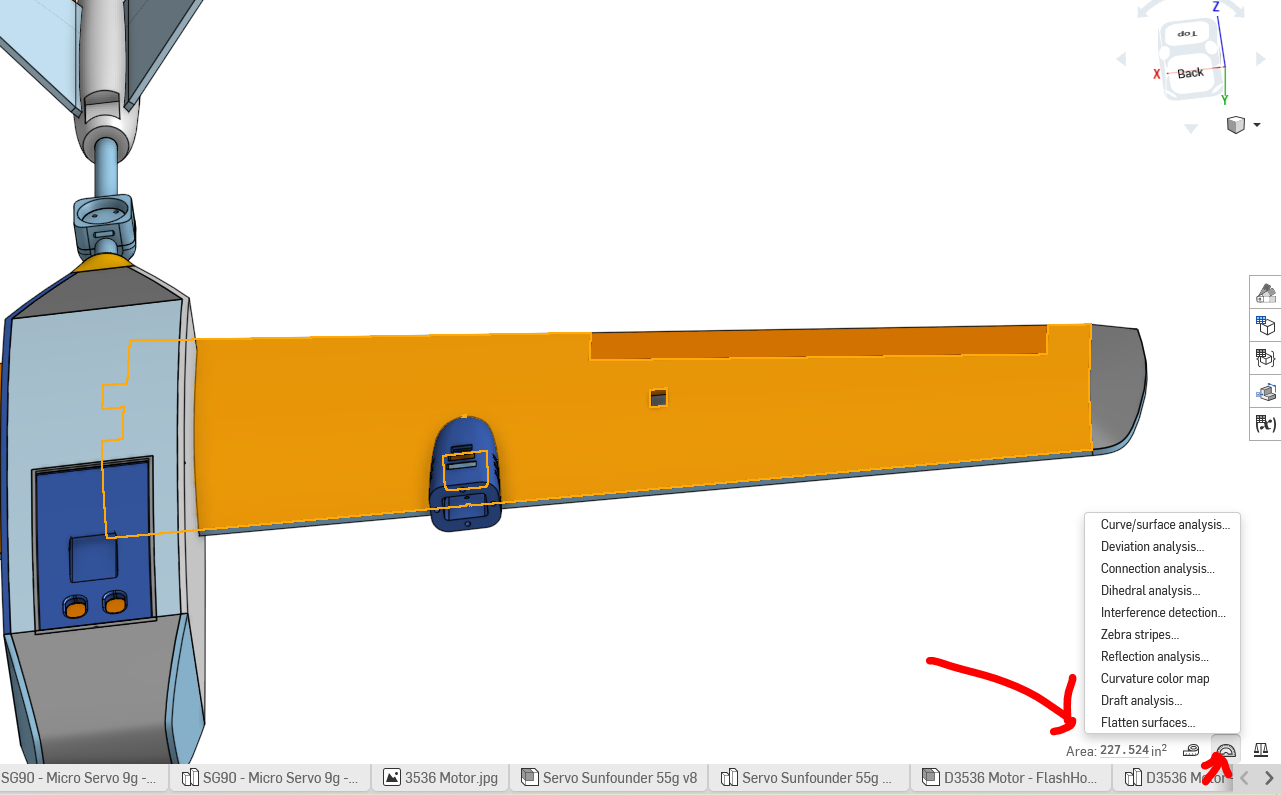
Oh sorry, I misunderstood what you said what you are doing..The flatten tool is right down here, to use it just click on the surface you want, then hit flatten surface and select the export option that you want (I usually do .svg)
1793677819976.png
 
The software/tool that comes to mind for me is "nTop", which allows a user to draw up a complete airplane very quickly. I don't know too much about it though, there might not be any cheap versions of it. All I know is that it was offered to my student design team but we didn't take up their offer because we wanted to design the plane ourselves lol