Help! rc pancake wing pre-design questions

LitterBug

Insanely Addicted Techno Geek Legendary Member
Moderator
You don't need a steerable tail wheel if you use differential thrust on the motors. You could probably get away with a tail skid or a simple pivoting tail wheel.
 

badpilot27

Active member
You don't need a steerable tail wheel if you use differential thrust on the motors. You could probably get away with a tail skid or a simple pivoting tail wheel.
i tried diffy thrust just after the tail wheel broke on the latest hop attempt and it seems to work but due to the main landing gear being so far out, the plane really tries to ground loop at pretty much any speed without at grippy surface like tailwheel keeping the nose in check
 

L Edge

Legendary member
i tried diffy thrust just after the tail wheel broke on the latest hop attempt and it seems to work but due to the main landing gear being so far out, the plane really tries to ground loop at pretty much any speed without at grippy surface like tailwheel keeping the nose in check
A couple of comments for you. Have an "sorta plane" like yours. Points in question.

1) With that heavy battery, 2 motors/props in front, where is the cg? Suspect not a match.
2)) a) Do you have cw and counterclockwise props.?
b) Are you turning them so LE of prop is turning in towards center (P-factor) Want a detail explanation, will discuss and Telnar1236 is also concerned. Causes uneven lift and turbulence.
3) Are you aware of ground effects due to your tilt of your wing near the ground especially when landing? Look it up.

So, as you add power, immediately the whole body (at an angle) lightens and tail wheel can't keep it straight so unless you apply rudder to prevent yaw, you won't get off ground. Or rudder and some up elevator up so plane skids along to gather speed and plane should lift.

I would practice some high speed taxi runs and get use to straight moving down runway before attempting flights.

 

telnar1236

Master member
You might also want to check if the main landing gear and prop thrust lines are perfectly straight. With counterrotating props you shouldn't get too much of a moment trying to turn your plane.

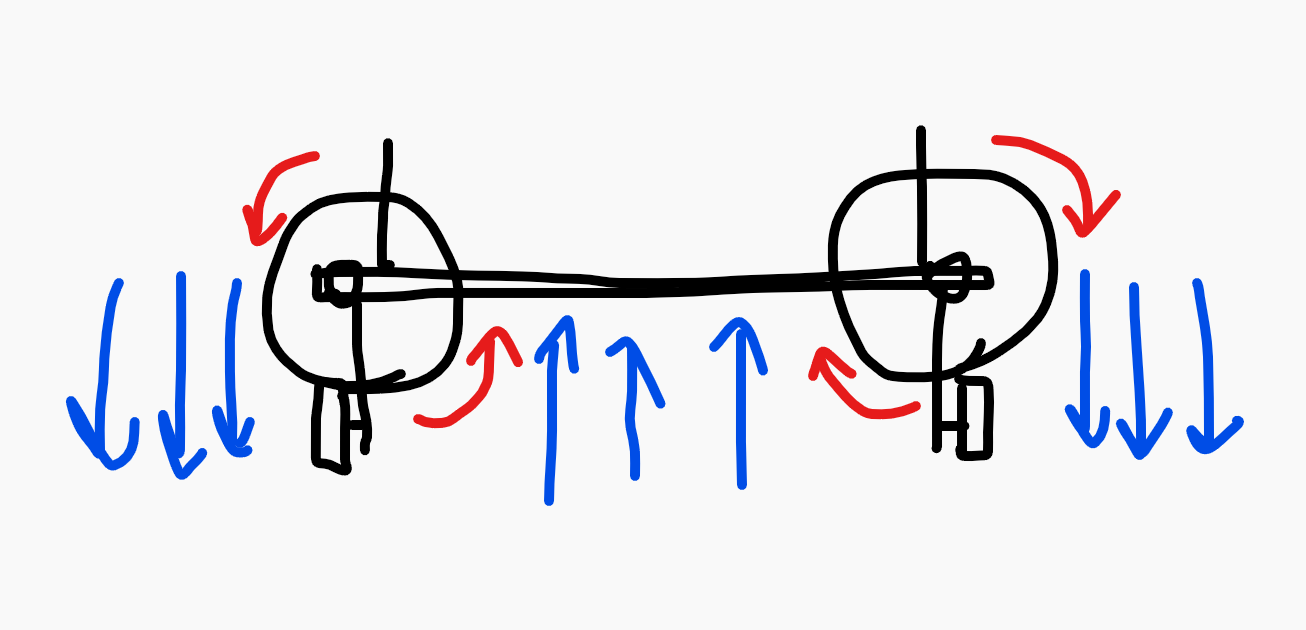
Honestly can't say I was too worried about the prop rotation direction. Looks like the props are spinning outwards already in the picture, and I'm not sure how much buffeting from inwards props would matter for an RC plane
 

L Edge

Legendary member
You might also want to check if the main landing gear and prop thrust lines are perfectly straight. With counterrotating props you shouldn't get too much of a moment trying to turn your plane.

Honestly can't say I was too worried about the prop rotation direction. Looks like the props are spinning outwards already in the picture, and I'm not sure how much buffeting from inwards props would matter for an RC plane
Advantage, with the props turning inward when you are landing, it continues to produce lift and better control as you slow for landing and your control surfaces especially the pancake design. Ask me how I know.
 

telnar1236

Master member
Advantage, with the props turning inward when you are landing, it continues to produce lift and better control as you slow for landing and your control surfaces especially the pancake design. Ask me how I know.
I'm thinking with the props all the way on the outside of the wing, for this design an outwards rotation will do more to help lift since there isn't any wing outboards of the prop - generally, I'd agree, inwards rotation is better though
1783185110872.png
 

badpilot27

Active member
I'm thinking with the props all the way on the outside of the wing, for this design an outwards rotation will do more to help lift since there isn't any wing outboards of the prop - generally, I'd agree, inwards rotation is better though View attachment 259054
at the moment i have outward spinning props since the full scale examples have them but if they're worse i may tryout inward spinning props
 

L Edge

Legendary member
I'm thinking with the props all the way on the outside of the wing, for this design an outwards rotation will do more to help lift since there isn't any wing outboards of the prop - generally, I'd agree, inwards rotation is better though View attachment 259054
My approach with airflows is to actually build something and see. I did a UFO which was a sheet of foam, no rudders, and 2 motors mounted at the edge and rudder controlled by a FC. Turning props inward gave me this video. Turning props outward caused an out of control piece of foam that I tried 3 times to fly and quit with a crunched and had to trash.

Now on another plane, I turn them outward and reduced the drag because it interacted with the vortex. Go figure.
 

L Edge

Legendary member
If the props spin outwards on the full scale too, that's a pretty good indication you got it right
I know the pancake will fly either way. Outside rotation will reduce the vortex and inside will add lift.

Takeoff, no problem, after he solves takeoff run with gear.
Flight and landing are the problem. Flight not bad, landing factors are throttle management, yaw, angle of the flat board to the ground which is critical, crosswinds, turns, speed, and ground effects. That is why for RC, I have them turn in to help. Fly 3 projects with this type of design.

Need to change site, sorry bp27
 

badpilot27

Active member
did another flight today with another hard but easily reparable crash

compounding oscillations were still prevalent so i think increasing vertical stabilizer size will help a lot with that
 

L Edge

Legendary member
Try flying it a little bit slower and use throttle and elevator to change the pitch to make it fly high and low. Just use rudder to steer. Too much power and it goes vert. Too little and it will drop like at the rock. To land, keep some power on.