

telnar1236
Master member
I've seen a lot of people using AI to estimate top speeds for their planes lately and was curious as to how good of an estimate AI could actually give. Coming into this, I predicted it would be pretty poor, but overall it did better than I expected. I've been developing a series of speed planes over the past year or so, so I have a number of designs with measured top speeds ranging from 75 to 150 mph and powered by EDFs between 50mm and 80mm in diameter and 4s and 6s batteries, so it gives a fairly good data set to compare to.
I asked Gemini, Meta AI, Claude, Chat GPT, and Grok to predict top speed based on some photos of the plane, the wingspan, and powerplant specifications for 6 planes. Overall, Claude was the clear winner, fairly reliably overpredicting the speed by a few mph, followed by Gemini. Meta AI was the worst by a substantial margin.
I started with the following prompt and let the AI guide the conversation from there:
I'm going to give you a few pictures of rc planes and some basic information about them. Could you please try to predict the top speed based on that data? Feel free to ask additional questions to get additional information if needed. Assume I do not know the coefficient of lift or coefficient of drag.
I refused to give any information that was hard to measure or allowed the direct calculation of top speed but did correct obvious hallucinations. In addition, if the initial predictions were bad, I asked the AI to check any assumptions I thought were a bit sketchy and recalculate. I show both the initial values and any corrected values.
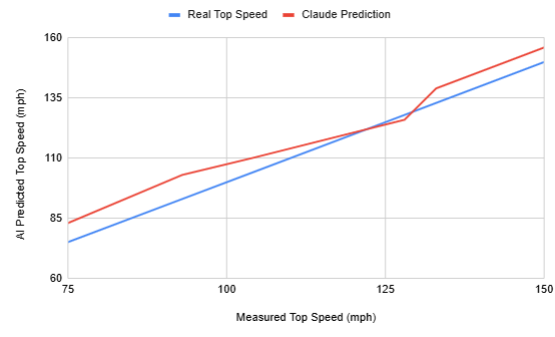
Starting with the best, Claude clearly listed assumptions and requested I check them before calculating a top speed. It did make an incorrect assumption that a plane's max top speed was at most the static efflux speed of the EDF which is incorrect, and which I corrected. After that, it did quite a good job at predicting the top speed off all the designs I entered except for my 70mm Ghost EDF. Overall, it's predictions were around as accurate as those I get from simplified CFD models but with a lot less work. In general, it overpredicted by a fairly consistent 5-6mph which is easy to correct for.
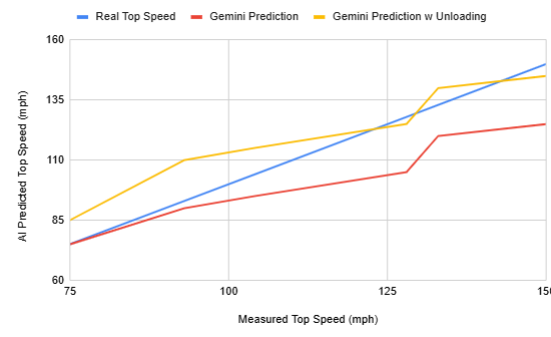
Next best was Gemini. It was less accurate and required a second go over to correct the same bad assumption about efflux speed Claude made, but overall, wasn't at all bad after correcting its calculations to allow for unloading of the motor. Gemini also acknowledged what we all know - a good paint job adds a few mph in top speed. I also needed to tell Gemini to assume all inlets were at least 100% FSA as otherwise it assumed substantial flow restriction automatically (probably a correct assumption for most EDFs so I don't think this was wrong, just not correct for my particular designs).

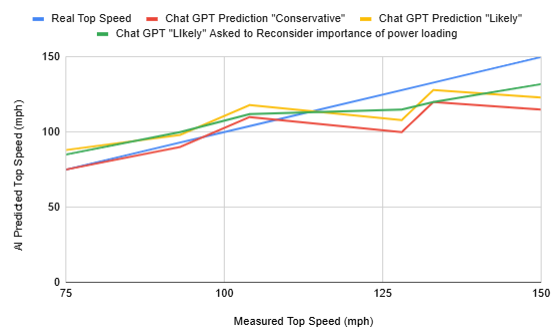
Then was chat GPT. For lower speeds (75mph, 93 mph, and 104 mph), it gave the best predictions of all the models, but at higher speeds it did poorly, It also incorrectly calculated a substantial difference in top speed based on power loading and did much better when asked to reassess after considering that. However, its answers were heavy in word-salad and it frequently gave a very wide range so I reported the "likely" and "conservative" values for the initial inputs.
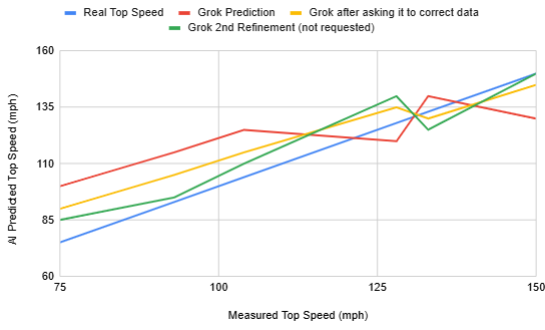
I'm not 100% sure what to make of Grok's predictions. It tended to give a fairly wide range and the real data did generally fall into the ranges it gave, but it generally seemed to be a bit unpredictable. When asked to correct for bad assumptions for example, it just subtracted a constant 15 mph from the 50mm and 64mm designs and added 10 mph to the 70mm and 80mm designs. It also provided me a third set of predictions unrequested as I was wrapping things up, which incidentally were the best ones of the lot. Grok was the only AI to realize that one of the planes had been posted about before and correctly identified my 50mm EDF jet trainer and gave its exact top speed at first.
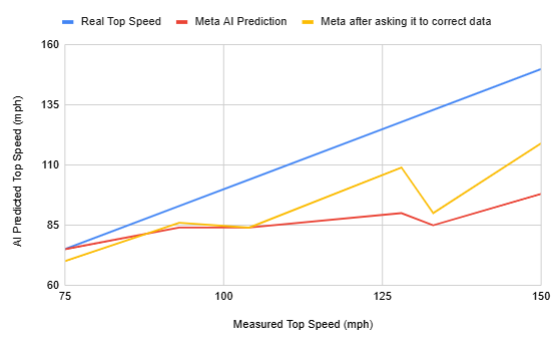
And then worst by a long way was Meta AI. It substantially underpredicted top speed both before and after being asked to check its assumptions. It also did a poor job of documenting the assumptions so that I couldn't identify the errors in the logic it was using.
I used the free versions of all of the different AIs so this should hopefully be helpful at pointing people in the right direction when it comes to using AI for these kinds of predictions. I wouldn't put much faith in these predictions in general, but if you're using them, Claude and Gemini are definitely the way to go.
I asked Gemini, Meta AI, Claude, Chat GPT, and Grok to predict top speed based on some photos of the plane, the wingspan, and powerplant specifications for 6 planes. Overall, Claude was the clear winner, fairly reliably overpredicting the speed by a few mph, followed by Gemini. Meta AI was the worst by a substantial margin.
I started with the following prompt and let the AI guide the conversation from there:
I'm going to give you a few pictures of rc planes and some basic information about them. Could you please try to predict the top speed based on that data? Feel free to ask additional questions to get additional information if needed. Assume I do not know the coefficient of lift or coefficient of drag.
I refused to give any information that was hard to measure or allowed the direct calculation of top speed but did correct obvious hallucinations. In addition, if the initial predictions were bad, I asked the AI to check any assumptions I thought were a bit sketchy and recalculate. I show both the initial values and any corrected values.
Starting with the best, Claude clearly listed assumptions and requested I check them before calculating a top speed. It did make an incorrect assumption that a plane's max top speed was at most the static efflux speed of the EDF which is incorrect, and which I corrected. After that, it did quite a good job at predicting the top speed off all the designs I entered except for my 70mm Ghost EDF. Overall, it's predictions were around as accurate as those I get from simplified CFD models but with a lot less work. In general, it overpredicted by a fairly consistent 5-6mph which is easy to correct for.
Next best was Gemini. It was less accurate and required a second go over to correct the same bad assumption about efflux speed Claude made, but overall, wasn't at all bad after correcting its calculations to allow for unloading of the motor. Gemini also acknowledged what we all know - a good paint job adds a few mph in top speed. I also needed to tell Gemini to assume all inlets were at least 100% FSA as otherwise it assumed substantial flow restriction automatically (probably a correct assumption for most EDFs so I don't think this was wrong, just not correct for my particular designs).
Then was chat GPT. For lower speeds (75mph, 93 mph, and 104 mph), it gave the best predictions of all the models, but at higher speeds it did poorly, It also incorrectly calculated a substantial difference in top speed based on power loading and did much better when asked to reassess after considering that. However, its answers were heavy in word-salad and it frequently gave a very wide range so I reported the "likely" and "conservative" values for the initial inputs.
I'm not 100% sure what to make of Grok's predictions. It tended to give a fairly wide range and the real data did generally fall into the ranges it gave, but it generally seemed to be a bit unpredictable. When asked to correct for bad assumptions for example, it just subtracted a constant 15 mph from the 50mm and 64mm designs and added 10 mph to the 70mm and 80mm designs. It also provided me a third set of predictions unrequested as I was wrapping things up, which incidentally were the best ones of the lot. Grok was the only AI to realize that one of the planes had been posted about before and correctly identified my 50mm EDF jet trainer and gave its exact top speed at first.
And then worst by a long way was Meta AI. It substantially underpredicted top speed both before and after being asked to check its assumptions. It also did a poor job of documenting the assumptions so that I couldn't identify the errors in the logic it was using.
I used the free versions of all of the different AIs so this should hopefully be helpful at pointing people in the right direction when it comes to using AI for these kinds of predictions. I wouldn't put much faith in these predictions in general, but if you're using them, Claude and Gemini are definitely the way to go.


